
BAFs seek to offer a smoother experience across market cycles, not the full upside of a bull market.

India's banking system liquidity surplus has significantly narrowed due to tax outflows, including GST payments, and higher cash reserve ratio balances. This tightening liquidity has pushed the weighted average call rate closer to the RBI's marginal standing facility rate, with market participants anticipating a persistent deficit in the coming months.
India's leading private-sector banks, including HDFC Bank, Axis Bank, and Kotak Mahindra Bank, reported robust deposit growth in the July-September quarter (Q2FY27), significantly aided by the Reserve Bank of India's concessional FCNR(B) swap window.

Investors who bought attractively valued IPOs and held on have earned strong returns, particularly when the money raised went into companies rather than into the pockets of exiting shareholders.

Former NITI Aayog vice-chairman Rajiv Kumar has urged the government to maintain zero-fee UPI transactions for several more years, arguing that the benefits of UPI as a public good outweigh the costs. This comes amidst the government's recent decision to introduce a 0.4% fee on person-to-merchant UPI transactions above Rs 2,000 from October 15, a move that has drawn criticism.

Investors should cap gold allocation at 10-15 per cent and consider staggered purchases through gold ETFs.

Under bullet repayment, the principal remains outstanding and unpaid interest raises the liability over time. This makes the LTV ratio more vulnerable to a sharp fall in gold prices.

The tax treatment of equity savings funds makes them appealing, especially to investors in higher income-tax brackets.

Of the 37,448 candidates registered for the Foreign Medical Graduate Examination (FMGE) in June, 36,288 appeared and 4,635 qualified.

India's statistics ministry has defended its newly released economic growth estimates, stating that revisions to last year's GDP and the divergence between different price measures reflect updated data and estimation techniques rather than an attempt to artificially boost headline growth.

Icra predicts that the top seven Indian cities will see an 8-11 per cent year-on-year growth in housing sales value by FY27, reaching approximately 7.9 trillion, primarily driven by the ongoing trend of premiumisation and a favourable product mix.

India's public sector banks (PSBs) have seen their net profit nearly treble over the past five years, reaching a record Rs 1.98 trillion in FY26, driven by significant improvements in asset quality and sustained lending growth across key economic sectors.

'The changes in its leadership team will help address the scepticism that has engulfed the bank over the recent period.'

A parliamentary panel flagged staffing shortages at NCERT and CBSE, inadequate education spending, falling enrolment and poor internet connectivity in government schools.

Indian listed companies experienced their fastest revenue growth in 15 quarters during Q1FY27, with combined net sales rising 18.4% year-on-year, while net profit grew 16%, primarily driven by mining, metals, and banking sectors, despite a contraction in operating margins due to higher input costs.

State-owned Bank of Baroda (BoB) reported a 72 per cent year-on-year (Y-o-Y) drop in net profit to 1,278 crore for Q1FY27 due to a $600 million out-of-court settlement related to NMC Health Plc. In contrast, Bank of India (BoI) saw its net profit rise by 36.23 per cent Y-o-Y to 3,068 crore for the same quarter, driven by healthy loan growth and improved asset quality.

The government maintained a strong pace of capital expenditure, which jumped nearly 24 per cent to Rs 3.40 trillion in April-June.

A Goldman Sachs report indicates that US and Indian equity markets are becoming less attractive due to lower free cash flow (FCF) yields as valuations rise, while European markets offer significantly higher yields. Concurrently, India's top-listed residential real estate developers experienced a moderation in pre-sales in Q1FY27, attributed to delayed project approvals, limited launches, and high year-ago bases, though underlying housing demand remains healthy.

N Chandrasekaran not only faces muted financial performance from the group's listed companies, but also mounting losses at Tata Sons' unlisted subsidiaries, many of which have been set up by him in the last decade.

Shareholder payouts by India Inc, including dividends and buybacks, increased by 2.2 per cent year-on-year in FY26 to $5.06 trillion, but this growth lagged the 18.8 per cent rise in reported net profit for the third consecutive year, leading to the lowest dividend payout ratio in 12 years.

ilver continues to outperform the yellow metal, with the gold-to-silver price ratio declining to its lowest level since 2013. The ratio fell to around 57 on Wednesday in the international market, from a five-year high of 100.8 at the end of April 2025.

There are hopes of a turnaround in overall corporate earnings after six quarters of single digit growth.

Luxury design by Pininfarina meets everyday performance in the latest Infinix Note 60 series smartphone.

FSN E-Commerce Ventures (Nykaa) reported nearly 30 per cent year-on-year revenue growth in Q1FY27, marking its highest revenue growth in 13 quarters, primarily driven by accelerated expansion in its fashion segment.

'Even lower middle class parents in cities opt for just one child. A son is a must.'

'After that the burdens of an ageing population will be upon us, and the share of working age population will shrink.'

Listed capital market companies in India delivered strong fourth-quarter earnings growth, with a universe of 12 firms posting 30 per cent year-on-year revenue growth and 19 per cent earnings growth in Q4FY26, despite mark-to-market (MTM) losses impacting headline profitability for some.

Most actively-managed equity mutual fund schemes outperformed their benchmarks despite volatility across domestic equity markets during the past year.

India's top 16 IT services companies distributed a record 1.3 trillion to shareholders in FY26 through dividends and share buybacks, a 36.3 per cent increase from FY25, even as the industry grappled with AI-driven business model threats and a significant decline in market capitalisation.
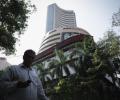
Indian equities are experiencing their sharpest rebound in years, with the BSE 500 index rallying 12.1 per cent so far this month, echoing Covid-era recoveries despite ongoing geopolitical uncertainty and earnings risks.

LAMF allows investors to access liquidity while staying invested.

Companies in the fast-moving consumer goods (FMCG) sector are losing favour with equity investors, with their price-to-earnings (P/E) ratio declining to its lowest level in six years, now trading at 38.8 times trailing earnings.

India's toll collection growth is projected to moderate to 5-7 per cent year-on-year in FY27, a 150-200 basis points reduction, primarily due to the economic impact of the West Asia conflict and a slowdown in commercial traffic, according to Crisil Ratings.

A State Bank of India report indicates a sharp increase in precautionary cash holding in India, with the gap between per capita currency in circulation and ATM withdrawals widening significantly, driven by global uncertainties despite record digital payment transactions.

The Indian rupee is highly vulnerable among Asian currencies, with Barclays and MUFG warning of a potential depreciation towards 100/$ if the West Asia conflict persists, driven by widening current account deficits and elevated crude oil prices.

We who were dreaming of being the third largest economy in dollar terms, have slid back to sixth, thanks to the falling rupee. We are moving about with begging bowls for investments and trade opportunities, which will be a while in materialising, if ever, notes Shreekant Sambrani.

The option chain offers a deeper insight into market sentiment, institutional positioning, and potential price movements. However, despite its advantages, many traders still underutilise it. We will explore why option chain data is most powerful and the reasons behind its underutilisation.

Dabur India's stock has fallen over 17 per cent since the start of the Iran war, driven by concerns over a weak monsoon, the West Asian crisis, and rising input costs, which are expected to impact the company's revenues and margins, particularly affecting its significant rural sales and international markets.

'Mobius made EMs investable and India his most enduring belief.'

Investors encountering underperformance must be patient.
